Fraud Without Borders: How Ad Tech and Payment Platforms Fight Financial Crime Together
A joint perspective from AdTech Holding and Nuvei
When people picture financial crime, they usually think of stolen card numbers and disputed charges first. What’s less visible is that a huge part of this fraud starts earlier in advertising, long before any payment happens.
A fraudulent transaction is frequently just the last visible step in a chain that starts with fake traffic: a bot clicks an ad, a compromised device generates a fraudulent lead, or a fake user profile completes a sign-up flow built purely to be monetized later. Seen from the ad tech side, fraud isn’t two separate problems split neatly between ‘advertising’ and ‘payments.’
It’s one criminal economy moving through whichever checkpoint is weakest. Ad platforms simply sit at an earlier checkpoint than payment providers, which means they often see the same bad actors before those actors ever reach a checkout page.
That’s the core argument for treating fraud prevention as a shared discipline rather than two parallel industries, and it’s the idea behind this joint piece from AdTech Holding and Nuvei.
What ad fraud actually looks like
Ad fraud comes in different variations, and each has a different relationship to the financial crime that follows it downstream:
- Bot traffic and click farms. Automated scripts or human-operated device farms simulate genuine engagement – clicks, impressions, app installs – to drain advertiser budgets or manufacture fake performance data.
- Fraudulent lead generation. Fake or incentivized sign-ups are built to pass basic validation checks. These often feed directly into payment fraud: a fake account exists specifically to test stolen card details or absorb a promotional credit.
- Device and identity spoofing. Fraud rings mask device fingerprints, IP addresses, and user-agent strings to bypass detection filters and appear as unique, legitimate users.
- Domain and SDK spoofing. Bad actors misrepresent where an ad actually appeared, redirecting advertiser spend toward fraudulent inventory instead of real audiences.
The detail that matters most here is that several of these tactics rely on the exact same infrastructure – device farms, spoofed identities, scripted behavior – that later resurfaces in account takeover, promo abuse, and payment fraud. A bot network built to fake ad engagement rarely gets thrown away after one use. It gets repurposed.
How AdTech Holding detects and prevents it
In 2025 alone, PropellerAds — one of AdTech Holding’s flagship advertising platforms — banned 1,676 advertiser accounts for fraud-pattern violations – cloaking, confirmed fraud, fake identity, multi-accounting, carding, and scam landing pages – with cloaking as the single largest category, at roughly 78% of those bans. The first half of 2026 is already on a comparable pace.

As one example of scale: on a single vertical alone, PropellerAds’ real-time systems flag and redirect confirmed fraudulent traffic continuously – roughly 1 in every 35,000 impressions over a recent 30-day window. That’s a high-confidence redirect layer sitting on top of, not instead of, earlier pre-bid scoring and blocklist filtering further upstream.
Fraud on the ad tech side rarely looks dramatic in the moment. It’s a cloaked domain, a device farm running the same script a thousand times, an account that keeps coming back under a new name. What changes the economics for fraud rings isn’t catching one instance; it’s making the pattern expensive to repeat. That’s what real-time scoring and cross-referencing with partners like Nuvei actually buys us.’
— Farukh Rakhimov, Head of Finance Operations and Compliance Group, AdTech Holding
Traffic quality enforcement at scale depends on layering multiple types of defense, because no single signal catches everything on its own:
- Real-time traffic scoring, which evaluates clicks and impressions against behavioral, technical, and historical signals before advertiser spend is finalized – not after the fact.
- Device and IP reputation systems, cross-referencing traffic sources against known fraud patterns and continuously updated blocklists.
- Behavioral analysis, looking for patterns real humans don’t produce: impossible click speeds, unnatural session paths, or geographic and time zone mismatches.
- Post-click and conversion validation, checking whether ‘engaged’ traffic actually behaves like genuine users further down the funnel – which is exactly where overlap with a payment partner’s fraud signals becomes valuable.
- Alignment with industry verification standards, such as MRC/IAB invalid traffic (IVT) definitions and independent third-party verification, so fraud rates aren’t a metric platforms grade on their own homework.

None of these methods work in isolation. A device that looks slightly suspicious on one signal but clean on the rest needs to be evaluated as a pattern, not a single red flag – which is the same logic payment risk teams apply to transactions.
The other half of the chain: fraud at the point of payment
If ad platforms are the earlier checkpoint, payment infrastructure is where the same fraud economy tries to cash out. Nuvei has built one of the world’s most connected payments infrastructures around that premise, connecting businesses to their customers in more than 200 markets, over 720 alternative payment methods and 150 currencies, all through one integration – with fraud and risk management running inside that same infrastructure rather than alongside it.
‘Businesses face substantial financial losses due to fraud, which can amount to billions of dollars annually.’
— Laura Miller, Chief Revenue Officer and Global Head of eCommerce, Nuvei, in an interview with PYMNTS
Holding those losses down isn’t the job of one fraud check at the end of the flow. It’s built into a few concrete layers:
- Network tokenization. Replacing static card numbers with dynamic, scheme-issued tokens and one-time-use cryptograms means stolen card data has a shorter shelf life: tokens survive card reissuance and expiry, which improves authorization rates while shrinking fraud exposure and the merchant’s PCI scope.
- Regulatory-grade screening. Real-time sanctions and PEP screening, multi-language name matching, adverse media scoring, and perpetual KYC monitoring sit underneath every transaction, with automated SAR and STR workflows feeding regulator-specific reporting.
- Fraud thresholds tied to regulation, not just risk appetite. Under PSD2’s Strong Customer Authentication rules, Nuvei manages Transaction Risk Analysis exemptions for qualifying transactions – but only by holding fraud rates at the levels regulators require to qualify for that exemption in the first place. Compliance and fraud prevention aren’t separate workstreams here; the second is a precondition for the first.
None of this runs as a separate module bolted onto payment processing. Nuvei’s Payment Orchestration hub evaluates every transaction against risk, cost, and compliance criteria in the same real-time decision sequence, before choosing a route, retrying a failed attempt, or stepping up authentication.
Fraud scoring isn’t a checkpoint a transaction passes through; it’s one input the routing engine weighs alongside everything else, on every single transaction.

Nuvei has also held PCI DSS Level 1 certification, the highest tier of the standard, since 2007, validated annually through independent security audits. Merchants routing payments through Nuvei inherit that certification, meaning it materially reduces their own compliance burden instead of adding to it.
Where the two sides of the ecosystem meet
This is the part that makes a joint analysis more useful than two separate ones: fraud signals detected in advertising traffic often resurface, sometimes days or weeks later, as fraud signals in a payment flow.
A device flagged for bot-like ad engagement is a meaningfully higher-risk device when it shows up at checkout. A user acquired through a fraudulent lead campaign is statistically more likely to be involved in a chargeback dispute or promo abuse further downstream.
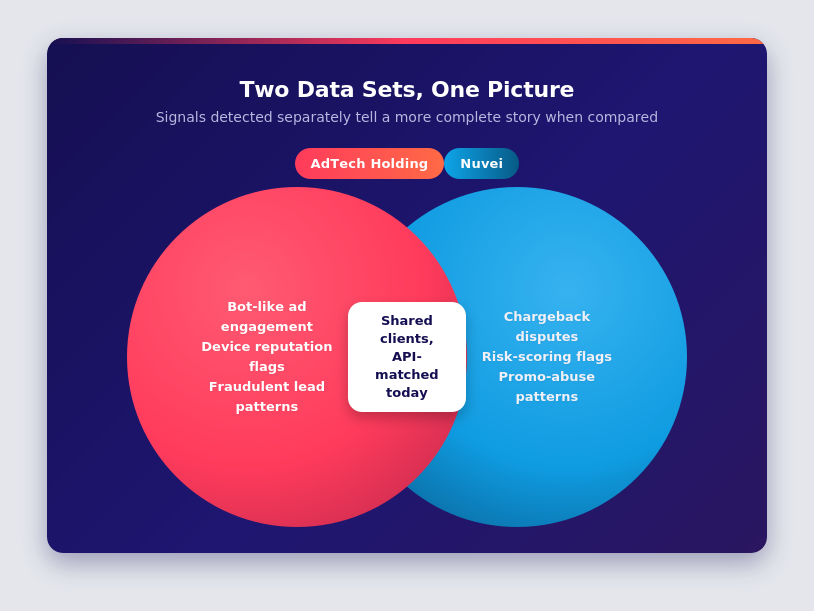
Right now, most of the industry treats these as separate detection systems that simply don’t talk to each other. In practice, for shared clients, AdTech Holding and Nuvei already compare notes at the data level – client information collected via API on our side is matched against Nuvei’s own records.
That said, this remains two parallel detection processes today, not a unified system – which is precisely the gap this partnership is pointing at.
This is where transaction-side expertise – the kind reflected in Nuvei’s work on chargeback fraud, dispute automation, and real-time risk scoring – becomes the natural counterpart to traffic-side fraud detection at the holding’s advertising platforms. The two data sets, viewed together, tell a more complete story than either does alone.
Why this partnership itself is the point
Fraud prevention runs on trust, and trust is hard to fake at scale. AdTech Holding and Nuvei didn’t choose each other by accident: both operate in categories – advertising and payments – where a single weak link in fraud controls becomes everyone’s liability.
A holding whose advertising platforms take ad fraud seriously and a payment provider that takes chargeback fraud seriously are, by definition, more compatible partners for clients who need both.
This piece is itself a small proof point of that: two companies willing to put their fraud posture in writing, side by side.
The systemic case
Ad fraud and payment fraud are both symptoms of the same underlying economics: fraud follows wherever verification is weakest, and the payoff is fastest. Solving it at only one layer – blocking bad clicks but not bad transactions, or vice versa – doesn’t eliminate the fraudulent actor. It just pushes them one step further down the funnel, into whichever system hasn’t caught up yet.
The more the ad tech and payments industries share pattern-level insight – not necessarily raw data, but a common understanding of what fraudulent behavior looks like at each stage – the harder it becomes for the same bad actors to keep exploiting the gap between ‘before the click’ and ‘after the charge.’